What Your Software Lets You Automate Decides Who Benefits From AI
Version 1.0 · August 2026
Influence over cost is highest when information is scarcest. Value management is the discipline of deciding well anyway, and of showing the work.
Multi-party agreements are contractual instruments before they are collaboration philosophies. Where the risk sits is a drafting decision, most projects discover theirs during a dispute, and schedule and cost are where the discovery gets expensive.
The most consequential construction technology of the last two decades is not a machine. It is the shift from drawing a building to modelling it, and from arguing about documents to coordinating one description of the work.
Standards describe what good information looks like. Governance determines whether anyone is obligated to produce it. Most projects have the first and not the second.
A digital twin is only as useful as the discipline of the data flowing into it. Most fail not at the modelling stage but at the moment responsibility for the information changes hands.
The technology works. What stops it is unresolved liability, absent standards, data security exposure and a fragmented supply chain. Every one of those is a governance problem, not a technical one.
Chapter 06 of 6 · At the frontier: write the rules for what is arriving
The technology works. What stops it is unresolved liability, absent standards, data security exposure and a fragmented supply chain. Every one of those is a governance problem, not a technical one.
Construction 4.0 is the building industry’s version of the fourth industrial revolution: machine learning, robots, drones, 3D printing, wearable sensors and connected equipment working on and around the jobsite. The technology already works: it is deployed commercially today. The unanswered questions are legal and organisational: who is responsible when an algorithm is wrong, who owns the data a robot captures, and which standard governs its accuracy. Those answers decide adoption.
Machine learning is already making decisions on construction sites. Models flag safety risk from site imagery, predict equipment failure from vibration and thermal signatures, classify defects from reality capture, and forecast schedule slippage from progress data. Autonomous platforms patrol buildings and produce the data those models consume. None of this is speculative. It is commercially deployed, and it sits inside the broader Construction 4.0 paradigm that links a digital layer of models and common data environments to the physical layer of the asset.
The demand side compounds it. Hyperscale data centres built to train and serve these models have become a principal driver of new industrial construction in the United States and a defining constraint on power infrastructure planning. Artificial intelligence is simultaneously a technology deployed on the jobsite and the reason a growing share of jobsites exist at all.
The documented impediments to adoption are consistent across the literature, and none of them is a technology problem: legal and contractual uncertainty, data security and cybersecurity exposure, absence of standards, longitudinal industry fragmentation, unclear value proposition, and workforce skill gaps. Each corresponds to a governance question. Who bears the risk of an autonomous system's error, who owns captured reality data, what standard governs its accuracy, and which contract says so.
The governance question
Machine learning already makes calls on construction sites: flagging safety risk, predicting failures, classifying defects, steering autonomous platforms. When one of those calls is wrong, somebody bears the loss, and on most projects no document says who. That silence, not the technology, is what this area exists to resolve.
None of this is speculative. Models flag safety risk from site imagery, predict equipment failure from vibration and thermal signatures, classify defects from reality capture, and forecast schedule slippage from progress data; autonomous platforms patrol buildings and produce the data those models consume. This practice has worked the terrain directly, including a team venture project applying LiDAR-equipped autonomous platforms to facility condition assessment, and applied work spanning wearable sensing, laser scanning, extended-reality inspection and machine-learning risk recognition. And the technology cuts both ways: artificial intelligence is simultaneously a tool deployed on the jobsite and the reason a growing share of jobsites exist at all: the hyperscale build-out this site treats as a capital-decision problem is the demand side of the same phenomenon.
The framework this chapter takes its name from was set out in Construction 4.0: An Innovation Platform for the Built Environment (Sawhney, Riley & Irizarry, eds., Routledge, 2020): two innovation streams, one physical and one digital, and a framework that links them. The families below are where the streams meet on United States jobsites, and each meets a different rulebook in a different state of readiness. Read together, they show the pattern this practice is built on: the technology runs ahead of the governance, and the gap is specific, nameable and closable.
Layout robots, semi-autonomous heavy equipment and quadruped platforms are working on sites now. A safety rulebook exists, but its lineage is industrial: ANSI/A3 R15.06-2025, whose first two parts bring ISO 10218:2025 into United States practice, and ANSI/RIA R15.08-1-2020, the industrial mobile robot standard, come out of manufacturing practice, and a construction site offers few of manufacturing’s constants: the floor changes, the zones move, the crews rotate. OSHA is explicit that “there are currently no specific OSHA standards for the robotics industry”; on site, robot hazards fall to generally applicable standards, the General Duty Clause, and guidance. So the operative questions are contractual: who is the standard’s “user” when the robot is rented, who defines its operating zone on a site that changes daily, and whose insurance responds to what it hits or misses.
Aerial progress capture, volumetrics and inspection are routine on large projects, and aviation law is the mature end of this chapter: 14 CFR Part 107 requires a certificated remote pilot, keeps flight within visual line of sight unless the FAA grants a waiver, and conditions operations over people on the aircraft’s category; since September 2023 a companion rule, 14 CFR Part 89, requires most registered aircraft to broadcast Remote ID in flight. What none of it touches is the data. Who owns the imagery, what accuracy it certifies when a pay application or an as-built claim rests on it, and what the neighbor under the flight path consented to are questions the certificate leaves open, and the contract picks up.
3D-printed buildings stopped being demonstrations when the permitting path arrived, and it arrived in two pieces: ICC-ES AC509, the acceptance criteria for 3D-printed concrete walls, and the 2024 International Residential Code’s optional Appendix BM for 3D-printed construction other than concrete. The wall can be approved. Who answers for it is a different question: where the printer vendor’s system ends and the engineer of record’s judgment begins, who owns the mix design, and who answers for a layer bond that fails in year nine. The code admits the technology; the contract still has to organise it.
Sensors, telematics and connected equipment turn a jobsite into a network, and every node is an exposure. Federal buyers already have a floor: the IoT Cybersecurity Improvement Act of 2020 (Pub. L. 116-207) directed NIST to set standards for connected devices and, since December 2022 and subject to narrow waivers, bars agencies from procuring, obtaining, renewing or using devices their chief information officer determines cannot comply. Private construction has no equivalent federal procurement floor: what security a connected site owes there is scattered across state law and regulators, which in practice leaves the project’s own contracts to say who secures what. That is why the question appears in this chapter’s checklist and not in a specification.
Distributed ledgers are the furthest from routine, and the most instructive about limits. Material provenance records and smart contracts that release payment on a trigger both work as engineering. What neither can do is decide whether the triggering fact is true: whether the work behind the pay application was performed, complete and conforming. Execution can be automated; verification is a human and institutional act, and deciding who performs it is a governance question no ledger settles.
Five families, one pattern. The rules that exist govern the machine, the aircraft or the printed wall. None of them reaches the questions a project actually litigates: who owns the data, what accuracy it certifies, who is answerable for error. Those stay with the contract, which is the map this chapter draws, and the venture that follows is where this practice tested it against a real machine.
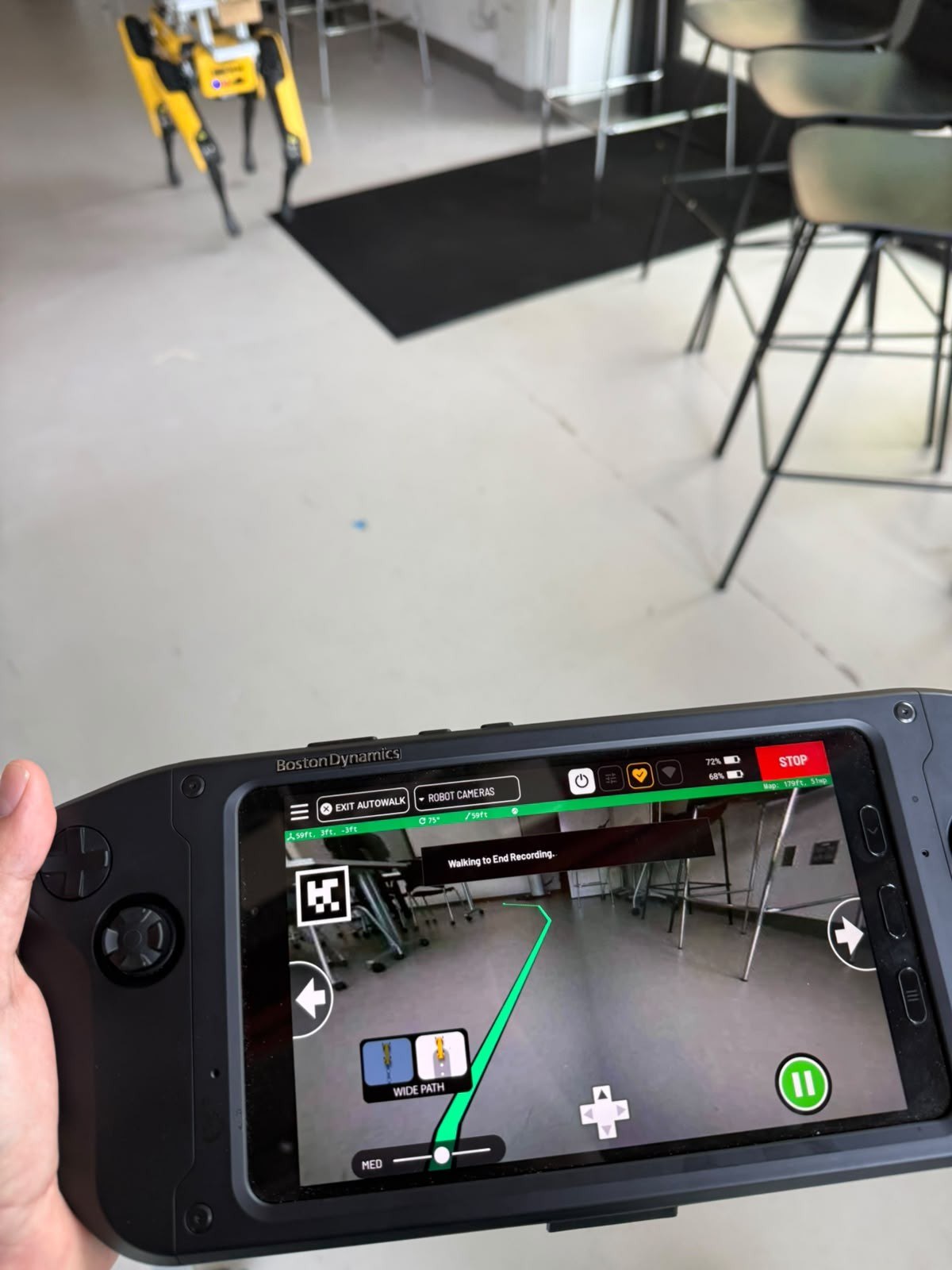
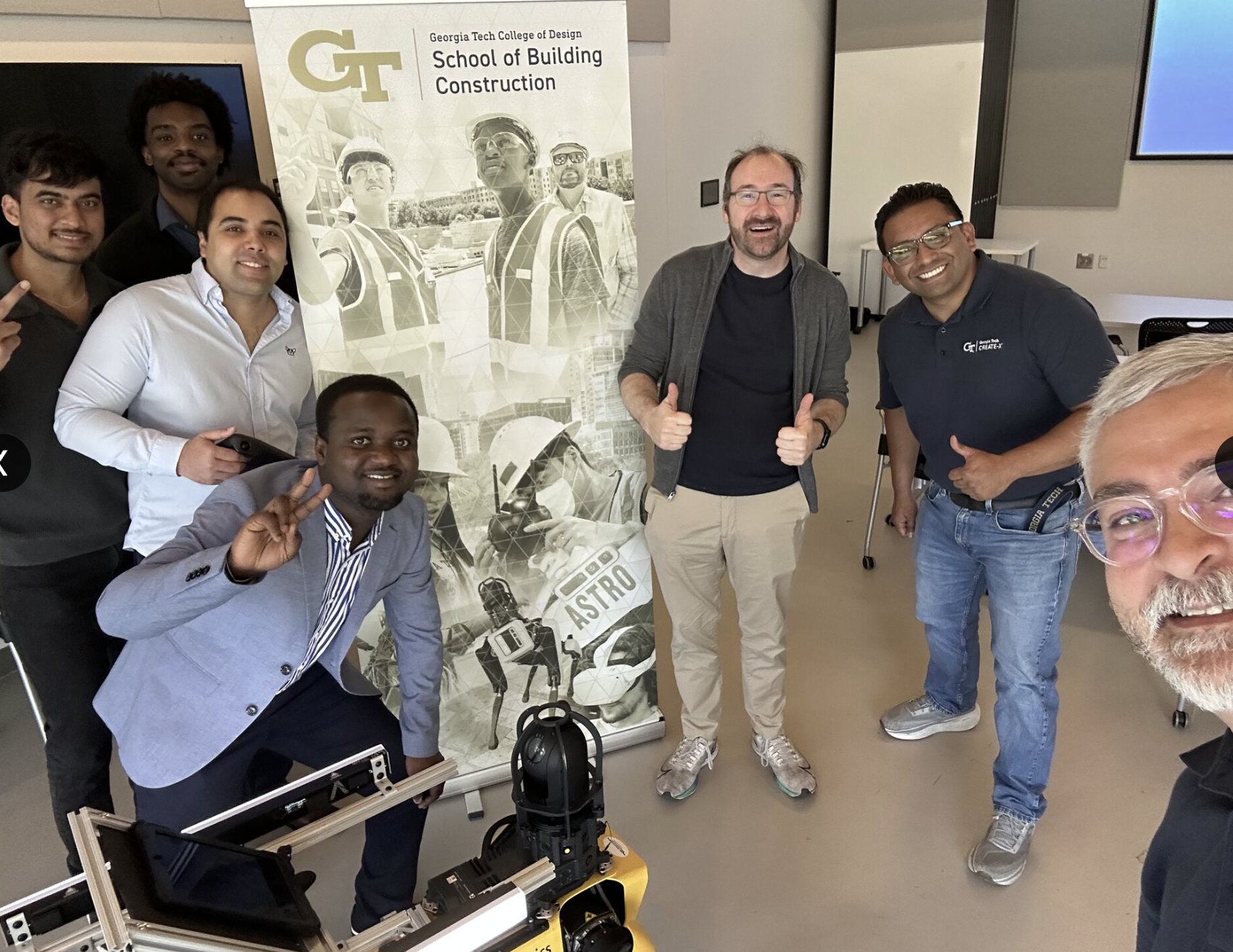
The venture project deserves its name here: CoreSight, an autonomous inspection concept for commercial buildings, developed with a four-member team; the author of this site is one of them. The platform: a commercial quadruped robot carrying thermal imaging, vibration sensing, 360-degree vision, LiDAR and leak detection, walking repeatable indoor inspection routes on its own, with anomaly detection running on the robot itself. A physical prototype was assembled, and the venture was developed with the support of Georgia Tech’s CREATE-X entrepreneurship program through the Jim Pope Fellowship, and presented publicly at the program’s close. What this practice keeps from it is the class of question the venture had to answer before a single unit could ever be sold: who owns what the robot records, where it may go and where it may not, what accuracy its alerts are held to, and who acts on a finding. Those are the questions of this chapter, met at prototype scale, on a real machine.
The peer-reviewed adoption literature is unambiguous about what is actually in the way. A systematic review in the Journal of Open Innovation (Regona, Yigitcanlar, Xia & Li, 2022) found that “the biggest challenge to incorporate AI on a construction site is the fragmented nature of the industry, which has resulted in issues of data acquisition and retention,” alongside applications that “need constant algorithm training,” “incompatibility with existing construction processes and practices,” and platforms that “constantly need investment to ensure data are up to date and accurate.” Add the skills finding (“insufficient skills, inadequate business models, and knowledge of AI for the construction industry”) and the pattern is complete: not one of the documented barriers is a modelling problem. Each is a question of who owns data, who verifies performance, who pays for upkeep, and who is answerable for error: governance questions, contract questions.
The United States has a national reference for exactly this. Directed by the National Artificial Intelligence Initiative Act of 2020, NIST published the Artificial Intelligence Risk Management Framework (AI RMF 1.0) in January 2023: “voluntary, rights-preserving, non-sector-specific, and use-case agnostic,” built on the premise that “AI systems are inherently socio-technical in nature.” Its core is four functions. GOVERN “is a cross-cutting function that is infused throughout AI risk management and enables the other functions.” MAP “establishes the context to frame risks related to an AI system.” MEASURE “employs quantitative, qualitative, or mixed-method tools… to analyze, assess, benchmark, and monitor AI risk.” MANAGE “entails allocating risk resources to mapped and measured risks.” A companion profile for generative AI followed in July 2024 (NIST AI 600-1). The framework names seven characteristics of trustworthy systems (“valid and reliable, safe, secure and resilient, accountable and transparent, explainable and interpretable, privacy-enhanced, and fair with harmful bias managed”), every one of which, on a jobsite, becomes a procurement and contract requirement.
Below the U.S. framework sits an international management-system standard. ISO/IEC 42001:2023, the world’s first AI management system standard, “specifies requirements for establishing, implementing, maintaining, and continually improving an Artificial Intelligence Management System (AIMS) within organizations.” For a construction firm the significance is structural: it is the same management-system logic that ISO 19650 applies to information and ISO 31000 applies to risk, extended to the algorithms now acting on project data. And it gives an owner something auditable to require of the vendors bringing AI onto the site (the discipline treated in depth in Information Governance).
Read as governance, the stack above converts into drafting decisions, and they are the same class of decision this practice treats everywhere else: the delivery method does not protect you, the enacted governance does. If an algorithm screens for safety risk, the contract should say what its role is, advisory or determinative, and who acts on its output. If a platform captures the site daily, a document should say who owns that data, who may train on it, and what survives project completion. If a model’s accuracy matters, some appointment should state the standard it is held to, the ground truth it is validated against, and the audit trail it must leave. And when the model is wrong (a missed hazard, a misclassified defect, a false schedule alarm), liability should sit where a drafter deliberately placed it, not where litigation eventually finds it. The technology is ready; the paragraphs are not. Writing them is the work.
NIST, Artificial Intelligence Risk Management Framework (AI RMF 1.0), NIST AI 100-1 (January 2023), and Generative Artificial Intelligence Profile, NIST AI 600-1 (July 2024); ISO/IEC 42001:2023, Information technology — Artificial intelligence — Management system; Regona, Yigitcanlar, Xia & Li, Opportunities and Adoption Challenges of AI in the Construction Industry: A PRISMA Review, Journal of Open Innovation: Technology, Market, and Complexity 8(1):45 (2022), DOI 10.3390/joitmc8010045. Quotations are verbatim from the cited documents.
Contributed to a team venture project applying LiDAR-equipped autonomous platforms to facility condition assessment, and to applied work covering wearable sensing and ergonomic risk assessment, laser scanning for as-built modelling, extended reality inspection, and machine-learning approaches to construction worker risk recognition.
Version 1.0 · August 2026
Short definitions for the acronyms and terms of art above. The complete vocabulary is in the A–Z glossary.